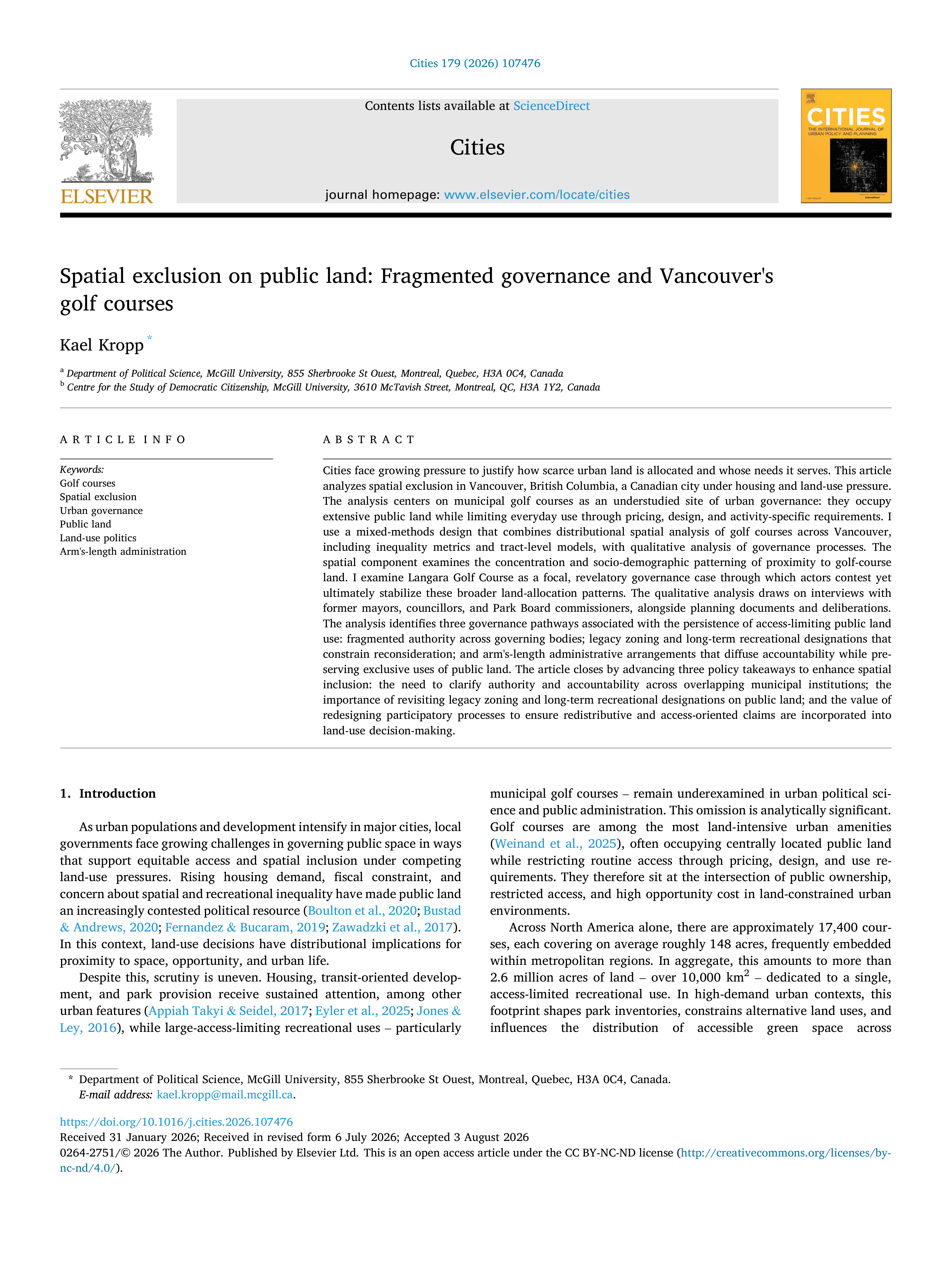
Spatial exclusion on public land: Fragmented governance and Vancouver's golf courses
Abstract
Cities face growing pressure to justify how scarce urban land is allocated and whose needs it serves. This article analyzes spatial exclusion in Vancouver, British Columbia, a Canadian city under housing and land-use pressure. The analysis centers on municipal golf courses as an understudied site of urban governance: they occupy extensive public land while limiting everyday use through pricing, design, and activity-specific requirements. I use a mixed-methods design that combines distributional spatial analysis of golf courses across Vancouver, including inequality metrics and tract-level models, with qualitative analysis of governance processes. The spatial component examines the concentration and socio-demographic patterning of proximity to golf-course land. I examine Langara Golf Course as a focal, revelatory governance case through which actors contest yet ultimately stabilize these broader land-allocation patterns. The qualitative analysis draws on interviews with former mayors, councillors, and Park Board commissioners, alongside planning documents and deliberations. The analysis identifies three governance…
Suggested citation
Kropp, Kael. 2026. “Spatial Exclusion on Public Land: Fragmented Governance and Vancouver’s Golf Courses.” Cities 179: 107476. https://doi.org/10.1016/j.cities.2026.107476.